
Best Microphones for Podcasting and Why Your Room Matters More
As an Amazon Associate I earn from qualifying purchases. Some links may earn us a commission at no extra cost to you.
The most expensive microphone in a bare room sounds worse than a cheap one in a room with soft furnishings, and that single fact should reorder how you spend. What listeners hear as amateur is almost never the microphone. It is the reflections off a desk, a bare wall and a window arriving a few milliseconds after your voice, which no amount of money on the mic itself removes. This is also why the standard advice to buy a condenser is backwards for most people. Condensers are more sensitive, so they hear the room, the keyboard and the fridge. Dynamic microphones are deliberately less sensitive and need you close to them, which means they pick up your voice and reject most of everything else. So I score these on room tolerance: how forgiving each one is of the untreated room you are actually recording in.
Top picks
Shure MV7+ — Best overall

- OBS CERTIFIED MICROPHONE: The MV7+ dynamic microphone delivers top-tier audio with seamless OBS integration. Voice Isolation Technology and built-in DSP ensure crystal-clear sound for podcasting, live streaming, YouTube, and content creation.
- LED TOUCH PANEL WITH MUTE CONTROL: Customize your mic with a multi-color LED touch panel and choose from 16.8 million hues, monitor levels, or enable pulse effects. Tap anywhere to instantly mute during streaming, gaming, or recording sessions.
- REAL-TIME DENOISER FOR CLEAN AUDIO: Advanced DSP with live noise reduction filters out ambient sound, fan noise, and room echo. Paired with Shure’s Voice Isolation Tech, it keeps your vocals sharp. Perfect for podcasting or remote work setups.
Why it wins: A dynamic mic with both USB-C and XLR outputs, from the company whose SM7B became the podcast standard, and the highest rated microphone on this page. The dual output matters more than it sounds: you plug it into a laptop today and into a proper interface in two years without replacing anything.
Pros
- Dynamic pattern rejects room reflections and background noise
- USB-C and XLR in one body, so it grows with your setup
- Auto level and built-in pop filter reduce what you have to get right
- Highest average rating in this roundup
Cons
- Costs several times what the budget dynamics do
- Small review base compared with the mass-market options
- Auto level can pump audibly if you move around while talking
Social proof: See rating and reviews on Amazon.
Trade-offs and who should skip: The one to buy if podcasting is going to stick. Skip it if you are testing whether you enjoy this. Skip it if you want manual control over everything rather than automatic help.
Scores: Performance 5/5 | Room tolerance 5/5 | Ease of use 5/5 | Value 3/5
FIFINE AmpliTank K688 — Best value dynamic
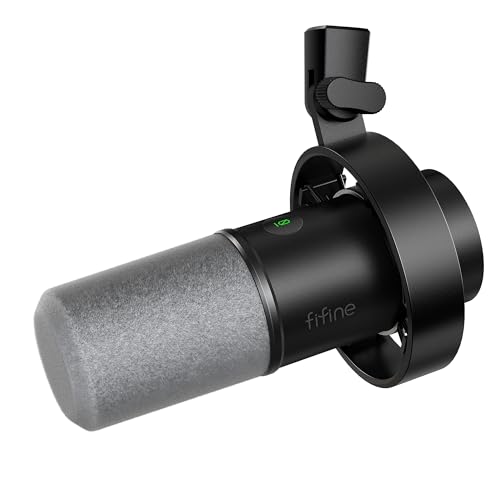
- [Clean Sound Quality] Featured with durability and adaptability, the metal-build podcast microphone, with SPL of 130dB, will not distort the audio from vocal, video or music recording to keep its originality. Quite directional cardioid pattern deals with background noise, like hard drives or computer fans. The microphone for PC delivers detail voice without much additional noise processing. (Arm stand, mic stand and XLR cable are NOT included.)
- [Upgrade XLR Output] XLR microphone reduces circuit noise interference and enhances the sense of audio space. Worked with S/N Ratio higher than 80dB, the dynamic microphone upgrades dynamics and details to makes your vocal easier to resonate. Use the streaming mic with sound card or mixer equipment accessories in your studio to present more natural and high-end audio in recording, vocals.
- [Convenient USB Output] Provided with both XLR to USB connections, the dynamic USB microphone is a significant benefit for you to record in various ways working with Windows or Mac OS. You can save time to finish your work quickly on desktop or laptop by plugging the 8.2ft USB cable directly without any further software or settings. The gaming microphone readily satisfies your daily work in studio, and also portable when out for work.
Why it wins: The same fundamental advantage as the expensive dynamics, at a fraction of the cost, with USB and XLR outputs and a headphone jack for monitoring yourself. Thousands of reviews on a metal-bodied dynamic mic means the basic proposition is proven rather than promised.
Pros
- Dynamic, so it handles an untreated room well
- USB and XLR outputs like mics costing far more
- Headphone jack for zero-latency monitoring
- Metal body rather than plastic
Cons
- Needs more gain than premium dynamics, so a weak interface leaves it quiet
- Onboard controls are basic
- Not as detailed as the Shure when the room is treated
Social proof: See rating and reviews on Amazon.
Trade-offs and who should skip: The right answer for most people starting out. Skip it if you already have a treated room and want the last ten percent. Skip it if your audio interface has weak preamps.
Scores: Performance 4/5 | Room tolerance 5/5 | Ease of use 4/5 | Value 5/5
Logitech Blue Yeti — The default recommendation, and the caveat

- Custom three-capsule array: This professional USB mic produces clear, powerful, broadcast-quality sound for YouTube videos, Twitch game streaming, podcasting, Zoom meetings, music recording and more
- Blue VO!CE software: Elevate your streamings and recordings with clear broadcast vocal sound and entertain your audience with enhanced effects, advanced modulation and HD audio samples
- Four pickup patterns: Flexible cardioid, omni, bidirectional, and stereo pickup patterns allow you to record in ways that would normally require multiple mics, for vocals, instruments and podcasts

Why it wins: Fifty-seven thousand reviews make this the most owned podcast microphone by a distance, and it earns much of that: four pickup patterns, genuinely plug and play, and detailed sound. It is also a condenser, which means it hears your room, and most people recording at a desk in a spare bedroom would sound better on a cheaper dynamic.
Pros
- By far the largest review base of any mic here
- Four pickup patterns cover interviews and multi-person recording
- Plug and play with no interface or driver setup
- Detailed sound in a room that has been treated
Cons
- Condenser sensitivity picks up room echo, keyboards and computer fans
- Side-address design means people speak into the top and sound wrong
- Desk vibration travels straight up the included stand
- Heavy and takes up real desk space
Social proof: See rating and reviews on Amazon.
Trade-offs and who should skip: A good microphone recommended for the wrong rooms. Skip it if you record in a bare room with hard floors. Skip it if you cannot mount it on a boom arm away from the desk.
Scores: Performance 4/5 | Room tolerance 2/5 | Ease of use 5/5 | Value 4/5
MAONO PD200W — Best if you need to move
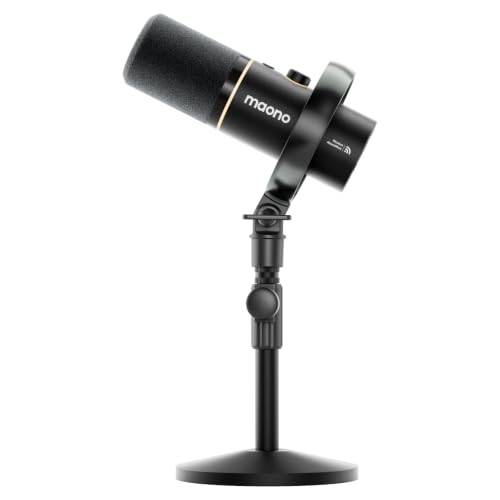
- Cut the Cables, Free to Pod - Dynamic microphone MAONO PD200W hybrid enjoy 3 ways for broadcast audio: go wireless for maximum freedom, USB for easy plug-and-play on phone, tablet, or computer, or XLR for a pro-level stable setup with audio interfaces
- Simple Setup, Studio-Level Sounds - With a premium 30mm dynamic capsule and cardioid pickup, the mic delivers studio-quality vocal reproduction for podcasting, streaming, and vocal recording. It achieves an ultra-clean 82dB signal-to-noise ratio and handles up to 128dB SPL without distortion
- Two Voices, One Perfect Conversation - PD200W supports a single receiver to connect two wireless desktop mics for duo podcasts or interviews. Records each mic to its own track so you can edit with precision, and keep every conversation crystal clear. The device also captures audio and video in perfect sync directly on the camera, eliminating the need for post-production alignment. (Note: Camera/Lightning accessories are sold separately.)
Why it wins: A dynamic mic that also works wirelessly, which solves a problem the others cannot: recording someone who will not sit still, or a two-person conversation where a cable across the room is a trip hazard. It keeps the dynamic capsule, so it still rejects the room.
Pros
- Wireless operation without giving up the dynamic capsule
- XLR and USB as well, so it works wired when you want
- Noise cancellation and software bundled
- Desktop stand included
Cons
- Wireless adds a battery to remember to charge
- More failure points than a plain wired mic
- Smaller review base than the established names
- Bundled noise cancellation can sound processed if pushed
Social proof: See rating and reviews on Amazon.
Trade-offs and who should skip: Flexibility bought with complexity. Skip it if you record sitting at one desk. Skip it if you want the fewest possible things that can go wrong mid-recording.
Scores: Performance 4/5 | Room tolerance 4/5 | Ease of use 4/5 | Value 3/5
BEACN Dynamic USB Microphone — Best compact desk mic

- DYNAMIC USB MICROPHONE FOR PC, GAMING & STREAMING – The BEACN Dark captures rich, full-bodied vocals while rejecting keyboard clicks, fan noise, and room echo. Get broadcast-quality sound with direct USB-C connection - no audio interface, no mixer, no extra gear. The ideal desktop microphone for gaming, streaming, podcasting, and content creation right out of the box.
- BUILT FOR TWITCH, YOUTUBE & PODCAST RECORDING – Purpose-built for content creators, this streaming microphone delivers crisp, professional audio for live streams, YouTube videos, Discord, OBS, and podcast mic setups. The dynamic capsule focuses purely on your voice so your audience always hears you clearly, whether you're a daily streamer or a weekend podcaster.
- ADVANCED BEACN SOFTWARE – Shape your sound with full multi-band EQ, compression, bass enhance, and patent-pending adaptive noise suppression through the BEACN app. Route audio directly inside the BEACN app for a clean, seamless streaming and recording setup with no extra equipment required. Ideal for gamers, ASMR creators, podcasters, and streamers who want professional control without the complexity.
Why it wins: A dynamic capsule in a small, low-profile body with onboard processing and headphone monitoring, designed to sit on a desk without dominating it. If the microphone also has to live in a room you work in, size stops being a vanity concern.
Pros
- Dynamic capsule in a genuinely compact body
- Onboard DSP handles basic processing without software
- Headphone monitoring built in
Cons
- Lowest average rating of the five
- USB only, so no path to an XLR setup later
- Smaller review base than the mainstream options
- Onboard processing is not adjustable in the depth some will want
Social proof: See rating and reviews on Amazon.
Trade-offs and who should skip: Small and capable, with a ceiling. Skip it if you might move to an interface and XLR later. Skip it if desk space is not the constraint.
Scores: Performance 4/5 | Room tolerance 4/5 | Ease of use 5/5 | Value 3/5
Quick compare
- Best overall: Shure MV7+, dual output, priciest here
- Best value: FIFINE AmpliTank K688, needs decent gain
- Most owned: Blue Yeti, a condenser that hears your room
- For moving around: MAONO PD200W, a battery to charge
- Smallest: BEACN dynamic, USB only
Two things worth doing before you upgrade the microphone. Get close to it, because dynamic mics are designed to be spoken into from a hand’s width away and most of the thin, distant sound people blame on cheap gear is simply sitting too far back. And soften the room: a rug, curtains, a bookshelf or even recording in a wardrobe will do more for how you sound than the difference between any two microphones on this page.
As an Amazon Associate, I earn from qualifying purchases.